| Getting your Trinity Audio player ready... |
Austin could face a water shortage of 32 billion to 98 billion gallons — the annual water use of 320,000 to 980,000 homes — by 2070 if new water conservation or use strategies are not introduced, according to city-owned utility Austin Water.
Expanding commercial water reuse, the Austin City Council authorized additional funding for Austin Water’s existing GoPurple pilot incentive program at Thursday’s meeting. The pilot’s extension will draw up to $4 million from the city’s general fund for the upcoming fiscal year.
Continuing the GoPurple program advances Austin’s Water Forward Plan and expedites a burgeoning water reuse strategy amid rising demand and uncertain supply. However, doubts remain among local resource experts concerned about the program’s long-term sustainability and cost.
Some Austin Water customers are required by city code to connect to the utility’s reclaimed water system and implement onsite water reuse strategies. Affordable housing projects are exempt but can connect voluntarily.
The GoPurple program helps customers for connection and reuse through a Community Benefit Charge of $0.15 per thousand gallons, or a $1.47 monthly cost to ratepayers, according to Austin Water.
“The GoPurple incentive is a really great way to fill a gap in getting water reuse to projects that just won’t (connect). I think that starts with affordable housing,” District 5 Council Member Ryan Alter told the Austin Free Press. “I’m really glad that we approved it today.”

Credit: Shelby Ligon
The extension of the GoPurple pilot program came before the city’s Resource Management Commission on Sept. 15 and the Water and Wastewater Commission on Sept. 16. Though both panels approved recommendations to extend the program, commissioners raised questions about long-term feasibility amid rising utility costs.

Paul Robbins, a longtime consumer advocate, was the only commissioner to abstain from the recommendation for action. He told the Austin Free Press that he supports the expansion of water reuse technologies but felt frustrated that Austin Water is still reimbursing required connections at the expense of ratepayers.
“I didn’t want to vote against it, because I believe wholeheartedly in what they’re doing,” Robbins said. “I just couldn’t continue to go along with this open-ended spigot of money without some scrutiny, so I did the only thing that I was allowed to do, which is abstain loudly.”
Going purple
Austin’s Water Forward Plan, adopted in December 2018, highlighted an “urgent need for long-range water conservation and reuse strategies.” This prompted Austin Water to develop a regulatory program for onsite water reuse technologies that collect stormwater, rainwater, condensate, graywater or foundation drain water for non-drinking uses.
In 2020, the city amended its land development code to require developments smaller than 250,000 square feet to reuse water for cooling and developments larger than 250,000 square feet to reuse water for cooling, irrigation and toilet flushing.
“New buildings must essentially bring their own supply,” Robbins said.
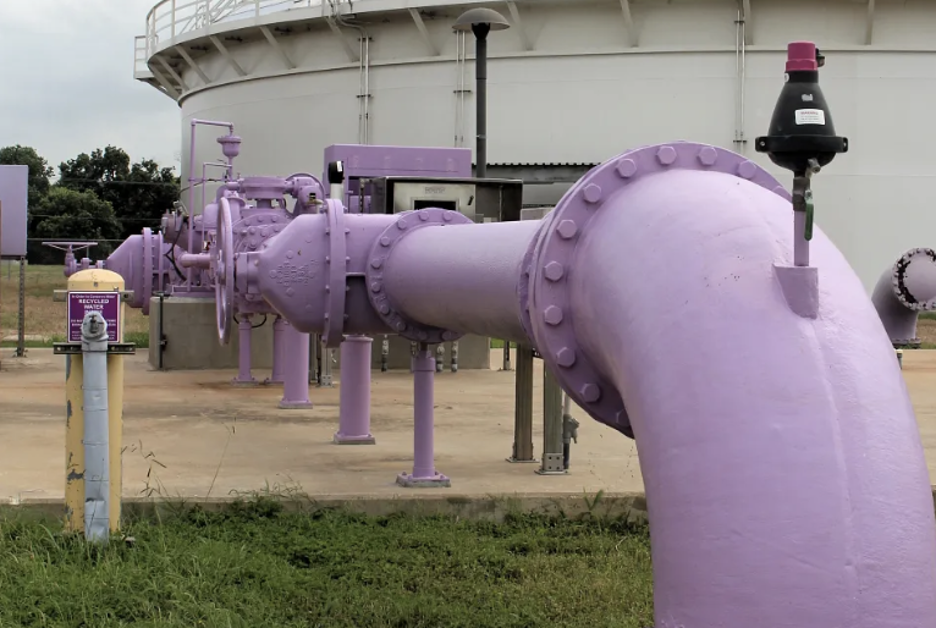
In addition to requiring onsite reuse, Austin Water treats wastewater for non-drinking uses and distributes that water via a network of purple pipes to avoid confusion with drinking water lines. In 2024, the land development code was amended again to require any development within 250 feet of a reclaimed water line and developments over 250,000 square feet within 500 feet to connect to the purple pipes.
The GoPurple pilot incentive program for onsite water reuse and reclaimed water connections was first adopted by the city council in March 2024.

Credit: Piper Guinn
Reuse, reclaim, reimburse
Twenty reclaimed water projects and 36 onsite reuse projects have been approved by Austin Water through the program, saving an estimated 74.1 million gallons of drinking water per year so far, according to a utility presentation. Specific site information, including project names, estimated water use and location is unknown.
Affordable housing projects are exempt from reuse and reclaimed connection requirements if:
- at least 50% of on-site rental units are reserved for residents making 60% or below the median family income and
- at least 50% of on-site owned units are reserved for residents making 80% or below the median family income.
Only those exempt projects qualify for a larger rebate of up to $1.5 million; all other projects are eligible for a rebate of up to $500,000, per the resolution adopted Thursday. Funding will be approved on a first come, first served basis.
For reclaimed connections, approved projects must connect within three years and maintain connection for at least 10 years to receive reimbursement. Once construction is complete, projects must submit a reimbursement request to Austin Water.
Only costs associated with connecting new supply lines to the existing reclaimed water system, or dual plumbing hard costs, are eligible for reimbursement. An additional 30% of those dual plumbing hard costs is provided to cover contracting fees.
Pushing past the pilot
While discussing the program, members of both commissions asked Austin Water how long the program would be considered a “pilot,” as GoPurple is entering its third year.

“Are there specific things we’re looking for so that this can stop being a pilot and start being a program?” asked Water/Wastewater Commission vice chair Marcela Tuñón. Austin Water staff replied that they sought additional applicants and data.

“We’re just two years into the program. We have had limited applicants at this point, but we are expecting more in the future,” Austin Water supervising engineer Katherine Jashinski responded.

“Timewise, I think you could argue it’s no longer a pilot, but demand-wise, it’s still in its infancy,” added Austin Water Deputy Director of Business Services Joseph Gonzales.
The GoPurple program’s budget was $5.6 million during its first year, but was reduced to $4 million the following year. Austin Water made the reduction because it “hadn’t been seeing quite the demand we had been budgeting for,” Gonzales stated.
Jashinski identified market transformation toward reuse technologies as a strong goal for the program, and that it’s difficult to measure given the smaller-than-expected volume of applicants. She also stated that Austin Water has heard anecdotally from commercial customers about high construction bids from contractors and lack of information about water reuse.
The Resource Management Commission suggested that Austin Water assess efforts underway at Austin Energy, another city-owned utility, to expand market transformation incentives for renewable energy. The suggestion was seconded by the Water/Wastewater Commission with a request to report back on useful findings.

“We just would love to hear what y’all learn,” commissioner Evan Wolstencroft told Jashinski.
Jashinski told the Water/Wastewater Commission that Austin Water hopes to connect with Austin Energy staff members who have successfully implemented transformation incentives in the renewable energy market, and that the utility will look for ways to measure progress.
“As we’re trying to change behaviors and change the way buildings are designed, I think these incentives are really important,” Jashinski said. “We just don’t have a ton of data at this point to really know what metrics or goals we should have. That’s something that we’ll continue to collect and work on.”
Piper Guinn is the health equity reporter for the Austin Free Press, covering the disproportionate health burden carried by the city’s most vulnerable. Piper is a native Texan and recent graduate of Whittier College, where she received a B.A. in political science.
Support for Austin Free Press reporting on water and environmental issues comes from the Jacob & Terese Hershey Foundation. Sponsors do not influence AFP’s editorial decisions.