| Getting your Trinity Audio player ready... |
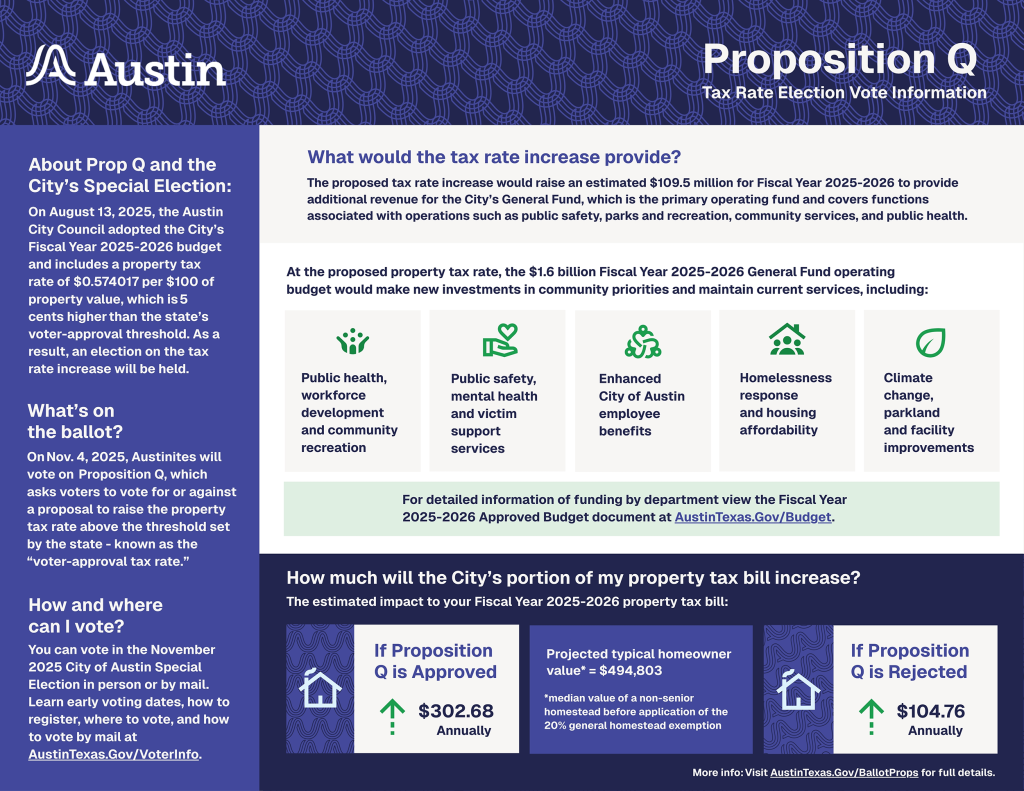
Austin voters slam-dunked the city council on Tuesday with a resounding rejection of Proposition Q – a proposal that would have permanently raised the city’s property-tax rate to generate roughly $110 million annually.

Image credit: Alberta Phillips.
Unofficial returns show the measure failing by nearly a two-to-one margin — 104,148 to 60,356 in Travis County and 5,023 to 2,491 in Williamson County — with results from Hays County not yet available. The outcome reflects broad skepticism about the Austin City Council’s fiscal management and raises new questions about how the city will balance its budget in the months ahead.
“Voters prioritized affordability,” Mayor Kirk Watson wrote in his “Watson Wire” newsletter after election results came in. “They’re worried about their finances, their grocery and utility bills, their property taxes, and more. They’re concerned about the stability of all levels of government, including city government. We need to give voters reason to trust us—to trust that we will strike the right balance between services and the funding needed to provide those services.”

Image credit: Mayor Kirk Watson.
Watson was among 10 council members who voted to put Prop Q on the ballot.
City leaders now face the immediate task of revising the fiscal year 2025 budget to close an estimated $33 million shortfall without additional revenue from Prop Q. The stunning result also raises doubts about whether future revenue-raising measures, including a possible vote next year related to the planned $1.6 billion Austin Convention Center reconstruction, will gain traction with voters wary of new taxes and big-ticket city expenditures.
Convention center opponents delivered petition signatures to the Austin City Clerk last month. If the clerk validates those signatures, the city must ask voters next May if they want to put convention center construction on hold for years. The clerk could announce the results of that validation process later this month.
Decisive rejection
Unofficial results showed Prop Q failing in nearly every precinct across the city. The proposal won marginal support just in the Hyde Park, Mueller, and Windsor Park neighborhoods to the north and east of downtown. Early returns suggest that voters were motivated by affordability concerns, with property-tax fatigue cutting across partisan and geographic lines.
Affordability was on the minds of voters nationwide. Pocketbook issues were centerpieces of the victorious campaigns of newly elected New York Mayor Zohran Mamdani and Virginia Governor Abigail Spanberger. Meanwhile, Texas voters approved 17 state constitutional amendments, including 10 that curtailed taxes for homeowners and businesses.

District 10 City Council Member Marc Duchen — the only council member to oppose Prop Q — called the outcome a “wake-up call.”
“It’s an acknowledgment that Austinites are struggling with economic uncertainty in an increasingly expensive city,” Duchen said. “City Hall has got to start acknowledging that instead of continuing to balloon the budget.”
Given the current economic climate, Austin political consultant Bill Miller said: “The election (Tuesday) was not thought out, poorly planned and poorly executed. Other than those flaws, it was a real success story.”
Duchen said he hopes the council will respond by commissioning a comprehensive efficiency study to identify savings and streamline operations, as Houston recently did. He added that the vote reflected not only financial anxiety but also was a “referendum on trust.”
“My hope is that we can seize this as an opportunity to restore our constituents’ faith in local government,” he said.
What’s next

Procedurally, the city is expected to revert to a slightly reworked version of the base budget that City Manager T.C. Broadnax first proposed in July. It held the property-tax rate at 3.5 percent above the no-new-revenue level, which is the maximum allowed without voter approval under state law.
Duchen said the Council could adopt the revised version as soon as Nov. 20, with modifications reflecting recent spending and staffing needs. With the defeat of Proposition Q, a median Austin homestead valued at $494,803 will see an annual tax increase of $105, according to the city. The measure’s passage would have tripled that tax increase to at least $303 a year.

The defeat of the Prop Q tax increase likely will result in department-level cuts or hiring freezes. The city of Austin employs roughly 14,000 people, and the potential impact on services and programs remains unclear. Brydan Summers, president of the American Federation of State, County and Municipal Employees Local 1624, said city workers are bracing for staff reductions.
“After (Tuesday), we did not resolve the city’s budget deficit,” Summers said. “I’m hopeful we can get through this next year without serious cuts, but by the following budget cycle, we’ll be talking about parks, libraries, and other non-essential departments.”
Summers said the union, which represents more than 4,000 non-sworn city employees, will press for transparency and a seat at the table as the city reworks its spending plan. While Austin’s civil-service rules provide a process for reductions in force, he said even reassignments can disrupt essential functions.
“You don’t want a nurse from Austin Public Health now taking calls for 311,” he said.
Affordability and trust

To many, the defeat underscored frustration with city leadership as much as opposition to higher taxes. Longtime civic activist Robin Rather said she heard the same refrain in nearly every corner of Austin.
“People in Austin are serious about affordability,” Rather said. “Most people I talked to were saying, ‘Are you kidding me? The last thing we need is a tax increase. Austin is already way too expensive.’”
Rather described the outcome as a “referendum on delivery” for a council that has often framed its agenda around affordability but, she argued, has not shown spending restraint.
“They say they’re affordability-first, but they haven’t delivered it,” she said. “There’s a callousness to this council that I haven’t seen in 30 years of watching councils, a willingness to say one thing and do the opposite.”
She cited recent council votes to advance major capital projects, including the $1.4 billion cap and stitch I-35 decking plan and $1.6 billion new Austin Convention Center, as city projects that appear to be out of step with a public squeezed by Austin’s high cost of living.
“Even if those don’t come from the same funding buckets, the symbolism matters,” Rather said. “People want basic essential services like public safety, public health, and social services, and they don’t want extravagances.”
City Impacts
Among the programs that could face budget pressure are Austin Public Health and its network of contracted services. That includes the city-funded Sobering Center, which provides short-term care for people detained for public intoxication as an alternative to jail or emergency rooms.
 At the Sobering Center, which provides around-the-clock care for people detained for public intoxication, CEO Laura Elmore LeBlanc said the vote adds uncertainty to an already strained budget. The center, created through a joint agreement between the city and Travis County, already is operating this year about $300,000 below its stated $2.8 million baseline, as intake numbers reach record highs. LeBlanc said maintaining safe staffing levels is increasingly difficult.
“Our costs keep rising because we’re serving more people every year, but the city keeps saying, ‘This is all you’re going to get,’” she said. “For a 24/7 operation, that’s not sustainable.”
For city workers and residents alike, one immediate challenge is to maintain confidence in essential services as City Hall re-evaluates spending. Summers said the defeat reflects deeper issues of perception between the city and its workforce.
“We don’t need lectures on affordability,” he said. “Our members feel it every day. Most of them can’t afford to live in the city of Austin. But they also know that when voters reject new revenue, it’s those same working families and the services they depend on that feel the impact.”

While Tuesday’s vote directly concerned the city’s property-tax rate, its ripple effects could extend beyond the current budget cycle. Political observers say the defeat may complicate efforts to pursue new capital funding or bond initiatives in the coming years, such as the $7.1 billion light rail initiative Project Connect, and other big-ticket expenditures. A representative of Austin United PAC, which collected the petition signatures opposing the new convention center, said the election results validate her group’s concerns about large-scale spending projects.
“Austinites are waking up and realizing this Council isn’t spending their money wisely,” PAC treasurer Tanya Payne said. “They want a voice in how their money’s being spent.”
Chad Swiatecki is a 30-year journalist who relocated to Austin from his home state of Michigan in 2008. He most enjoys covering the intersection of arts, business and local/state politics. He has written for Rolling Stone, Spin, New York Daily News, Texas Monthly, Austin Monitor, Austin Business Journal, Austin American-Statesman and many other regional and national outlets.